
For decades, the goal of search engine optimization was simple: get your website into one of the famous “10 blue links” on Google’s first page. But the landscape is changing rapidly. In 2026, many users no longer browse lists of links. Instead, they turn to AI-powered engines such as ChatGPT, Perplexity, Claude, and Gemini to ask conversational questions and receive direct, synthesized answers.
This shift raises an important question for businesses and publishers: how do you ensure your content becomes part of those AI-generated answers? If your brand wants to stay visible in this new AI-first world, you need to optimize not just for clicks, but for citations. This is where Generative Engine Optimization (GEO) comes in.
What is Generative Engine Optimization (GEO)?
Generative Engine Optimization (GEO) is the process of optimizing content so that AI search engines can understand it and use it when generating answers to user questions. While traditional SEO focuses on ranking webpages on search engine results pages (SERPs), GEO focuses on ensuring AI systems recognize your content as a reliable source.
Think of GEO as the evolution of SEO for the generative AI age. While traditional SEO helps you rank, GEO helps you get quoted.
For example, when a traveler asks an AI engine, “What are the best boutique hotels in Rome for couples?”, the AI does not simply show a list of links. Instead, it analyzes travel guides, hotel reviews, tourism blogs, and comparison articles to generate a summarized recommendation. If your content is clear, trustworthy, and well-structured, it may become one of the sources used to build that answer.
In practice, GEO focuses on improving:
- AI citations – ensuring AI tools reference your content in their answers
- Brand authority – building a reputation as a trusted source
- Structured information – organizing content so AI systems can easily understand it
- Trust signals across the web – reviews, mentions, and credible sources linking to your brand
SEO vs GEO: What’s the Difference?
| Traditional SEO | Generative Engine Optimization (GEO) | |
| Target | Google Search Results Pages (SERPs) | AI-generated answers |
| Platforms | Google, Bing | ChatGPT, Perplexity, Gemini, Claude, Google AI Overviews |
| Goal | Website clicks and traffic | Mentions and citations in AI responses |
| Tactics | Keywords, backlinks, metadata | authority, structured content, semantic clarity |
| Outcome | Users visit your site | AI synthesizes and quotes your content |
Traditional SEO and GEO are not mutually exclusive. In fact, strong SEO foundations are essential for GEO success. However, GEO expands the goal from simply ranking pages to becoming a trusted information source for AI systems.
How AI Search Engines choose sources
AI engines do not randomly generate answers. Platforms like ChatGPT, Perplexity, Gemini, Claude, and Google AI Overviews rely on retrieval systems and ranking signals to determine which sources to use when generating responses. Several factors influence whether your content becomes part of an AI-generated answer.
1. Topical authority
Websites that consistently publish high-quality content on a specific subject are more likely to be selected as sources. A site with dozens of detailed articles about a topic signals stronger expertise than a general blog covering unrelated subjects.
2. Clear, extractable answers
AI systems prefer content that includes:
- concise definitions
- structured lists
- comparisons
- question-and-answer formats
This makes it easier for AI models to extract reliable information.
3. Brand authority across the web
AI systems also analyze mentions and signals from across the internet, including:
- expert blogs
- news websites
- forums and community discussions
- reviews and testimonials
The more credible mentions your brand has, the more trustworthy it appears.
4. Technical accessibility
Technically optimized websites make it easier for search engines and AI retrieval systems to access and interpret content. Key elements include:
- fast loading speeds
- clean HTML structure
- schema markup
- clear headings
E-E-A-T still matters (even more now)
To be selected as a source in AI-generated responses, your content must demonstrate Experience, Expertise, Authoritativeness, and Trustworthiness (E-E-A-T). In the context of Generative Engine Optimization (GEO), these credibility signals play an even greater role, as AI systems increasingly rely on them to determine which sources are reliable enough to include in generated answers.
Expertise and trustworthiness
AI systems tend to favor factual, well-researched content written with clear expertise. Strengthening credibility means citing reliable sources, supporting your statements with data or studies, and writing with genuine expert insight rather than generic or keyword-stuffed text.
In practice, effective SEO copywriting still plays an important role: content should be written for humans first, while remaining structured and optimized so search engines and AI systems can easily understand it. In many cases, explanations based on real experience perform better than purely optimized content because they provide context and practical value.
Authoritative structure
Content structure also plays a major role in whether AI systems can extract useful information from a page. Formats such as Q&A sections, how-to guides, comparison tables, and step-by-step explanations make it easier for AI models to identify key points and summarize them accurately.
Breaking content into clear, self-contained sections increases the likelihood that individual paragraphs can be quoted or referenced in AI-generated answers.
Experience through web signals
AI platforms increasingly analyze signals from across the web to evaluate credibility. Discussions in industry forums, conversations on platforms like Reddit or Quora, and reviews on trusted websites all contribute to how a brand is perceived.
Positive reviews, authentic discussions, and consistent mentions across reputable sources help reinforce trust signals that AI systems may consider when selecting information.
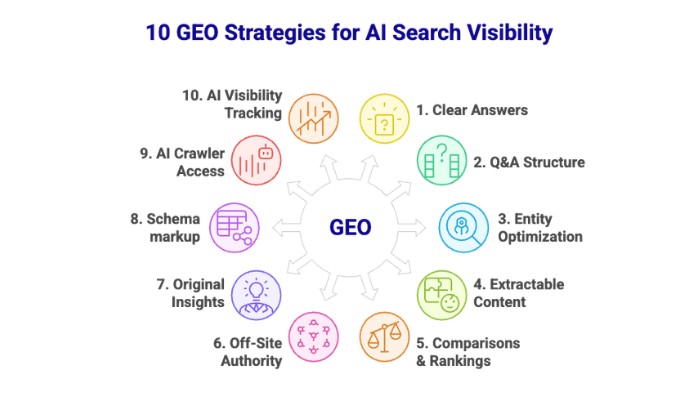
10 GEO Content Strategies that work in 2026
To succeed in AI-driven search, content must be structured so AI systems can understand and cite it. Let’s look at some of the most effective GEO strategies.
1. Answer questions clearly
AI systems prioritize content that directly answers user questions. Each section of your page should provide a clear and concise explanation of a specific topic. Starting with a direct answer before adding context helps AI engines identify the passage as a reliable source.
For example, instead of writing a long introduction about hotels in Rome, a section could begin with a direct answer such as: “The best boutique hotels in Rome for couples include properties located near the historic center, offering rooftop terraces and panoramic views of the city.”
2. Structure content for Q&A retrieval
AI engines frequently rely on question-and-answer structures when generating responses. Using headings that reflect real user queries makes it easier for AI systems to retrieve relevant passages.
For instance, a travel guide might include sections such as:
- What are the best boutique hotels in Rome for couples?
- Which hotels in Rome have rooftop terraces with views?
- What are affordable 4-star hotels near the Vatican?
Pages that clearly mirror the questions users ask AI assistants are more likely to be cited.
3. Optimize for entities
Modern AI systems interpret content through entities—such as brands, locations, people, and concepts—rather than isolated keywords. Clearly referencing these entities and explaining their relationships helps AI engines understand the context of your content.
For example, an article about hotels in Rome should clearly reference entities such as Rome, Vatican City, Trastevere, or specific hotel brands, rather than relying only on generic keywords like “best hotels.”
4. Format information for extraction
AI engines analyze content at the passage level, often extracting small sections of text rather than entire pages. Structuring information in a clear and organized way makes it easier for AI models to identify key insights.
Short paragraphs, concise definitions, tables, and structured sections help highlight important information and improve the likelihood that your content will be reused in AI-generated answers.
5. Use comparison lists and rankings
Comparison content performs particularly well in AI-generated responses because it provides structured and easily extractable information. Articles that compare tools, products, or services help AI systems summarize options for users.
Examples include pages such as:
- Top marketing automation platforms for small businesses
- Best boutique hotels in Rome for couples
- Top alternatives to a specific software tool
These formats align well with recommendation queries.
6. Build off-site authority
AI engines often favor information supported by trusted third-party sources. Mentions from reputable websites, expert contributions, media coverage, and positive reviews all contribute to stronger credibility signals.
When your brand is referenced across authoritative sources, AI systems are more likely to consider your content reliable and cite it in generated answers.
7. Publish original insights
Content that offers unique perspectives, expert commentary, or original data stands out in AI search environments. When your article provides information that cannot easily be found elsewhere, AI engines have a stronger reason to reference it.
Examples include industry studies, benchmark reports, expert analysis, or practical frameworks developed from real experience.
8. Implement schema markup
Schema markup helps search engines and AI systems better understand the meaning and context of your content. Structured data clarifies key information on your pages and helps AI platforms interpret and extract important details more easily.
Common schema types that support GEO strategies include FAQPage, Product, Review, LocalBusiness, and HowTo.
These structured signals help AI platforms identify important elements such as ratings, product details, and direct answers to user questions.
9. Ensure crawler accessibility
AI platforms rely on specialized crawlers to access and analyze websites. Ensuring that these crawlers can reach your content is an important technical step in GEO.
Review your robots.txt file to confirm that bots such as GPTBot, ClaudeBot, or PerplexityBot are not blocked, and maintain a clean, fast, and well-structured website architecture so AI systems can easily retrieve your pages.
10. Track AI visibility
Generative Engine Optimization is an ongoing process. Regularly checking how AI platforms reference your brand helps you understand where improvements are needed.
You can test queries on platforms such as ChatGPT, Perplexity, or Gemini to see whether your content appears in generated answers. SEO tools and monitoring platforms can also help track mentions, citations, and visibility across AI-driven search environments.
Looking for help implementing a GEO strategy?
I can help you develop a Generative Engine Optimization approach tailored to your business. Schedule a free consultation to discuss your goals.
Final Thoughts
Generative Engine Optimization is not just a trend; it reflects a major shift in how people discover information online. As AI-powered search becomes part of everyday research, brands are increasingly discovered directly within AI-generated answers rather than traditional search results.
For businesses, investing in GEO offers a clear competitive advantage. Companies that structure their content for AI-driven search can increase their visibility when users ask questions, compare solutions, or look for recommendations—positioning their brand as a trusted source before competitors even appear in the conversation.
Stay ahead of the competition in the age of AI search.
Get in touch today or request a free consultation to start improving your visibility in AI-generated results.
FAQs About Generative Engine Optimization
1. Why GEO Matters for Businesses in 2026
GEO matters because AI-powered search is changing how people discover information. Users increasingly rely on AI-generated answers to research products, compare solutions, and find recommendations.
When your content becomes one of the sources cited by AI systems, your brand gains visibility during the decision-making process. This can strengthen credibility, increase your industry authority, and influence potential customers before they even visit your website.
2. How can I check if AI engines are already citing my content?
You can test this by asking AI platforms like ChatGPT, Perplexity, Claude, or Gemini questions related to your niche. If your brand, article, or website appears in the generated response or cited sources, it indicates that your content is already contributing to AI-generated answers.
You can also use SEO platforms such as SEMrush or Ahrefs to monitor brand mentions, backlinks, keyword visibility, and emerging AI search features that reveal how your content appears in AI-driven results.
3. Is SEO Dead?
No, SEO is evolving. Traditional search engines still play a major role in how information is discovered online. However, the emergence of AI-generated answers is expanding the scope of visibility. SEO ensures your content is discoverable and indexed, while GEO ensures it is understood, summarized, and cited by AI systems. Businesses that combine both strategies will be best positioned to succeed in the evolving search landscape.
4. What structured data types help AI understand my pages?
Some of the most useful schema types include:
- FAQPage
- Review
- LocalBusiness
- HowTo
- Product
These schemas help search engines and AI systems interpret specific elements of your content more easily.
5. Does GEO matter for local businesses?
Yes. AI assistants increasingly respond to location-based queries such as:
- “best restaurants near me”
- “top dentists in my city”
- “recommended marketing agencies nearby”
Optimizing your website, reviews, and business listings increases the likelihood that your business will be included in those recommendations.
6. Will GEO replace SEO?
No. Generative Engine Optimization builds on traditional SEO foundations. Technical SEO, content quality, and website authority remain essential. GEO simply extends these practices by optimizing content so AI systems can extract and synthesize it when generating answers.
7. How should businesses approach GEO today?
The most effective approach is to combine:
- strong SEO fundamentals
- authoritative content
- structured data
- brand credibility across the web
Businesses that invest early in AI-friendly content structures will be better positioned as AI search continues to grow.